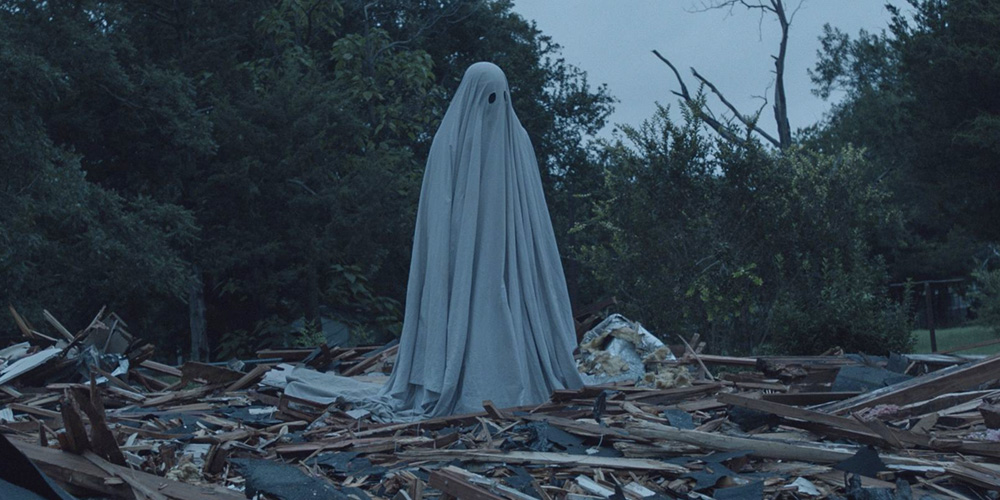
The Akan word ‘Saman’, commonly translated as “ghost” or “spirit of the dead,” carries layers of meaning that reveal how Akans traditionally understood life, death, and the world beyond. Like many old Akan words, its meaning may not be fully captured by a simple translation. Instead, its structure appears to reflect older beliefs about the end of human life and the state that follows death.
One possible explanation traces Saman to the words ‘sa’ and ‘ɔman’. In Akan, sa can mean “to finish,” “to end,” or “to come to a conclusion,” while ɔman refers to a nation, state, or condition of existence. Under this interpretation, ‘Saman’ describes a person who has entered the state where earthly life has ended. This idea aligns with traditional Akan views of death as a transition from one state of existence to another, rather than complete annihilation.
This interpretation becomes even more interesting when considered alongside the Akan word ‘Ɔdasanyi’. The term refers to a human being and can be understood as “a person whose days come to an end” (nyimpa a ne nda sa). Human life is therefore viewed as temporary, bounded by time and mortality. When the days of the ‘Ɔdasanyi’ are exhausted, he enters the condition or realm represented by ‘Saman’. The relationship between the two words reflects a worldview in which life and death are connected stages of a single journey.
Another possible explanation links Saman to ‘sasa’, a term associated with wild forest spirits in Akan tradition. In this reading, Saman may have emerged from the combination of ‘sasa’ and ‘ɔman’, referring to the realm, state, or community of spirits. Forests occupied a special place in the Akan imagination and were often regarded as spaces inhabited by unseen beings. It is therefore not surprising that concepts relating to spirits and the supernatural would draw from this older spiritual vocabulary, especillay when ‘esiei’, cemetery, is usually located in the deep forest in Akan and Ghanaian culture.
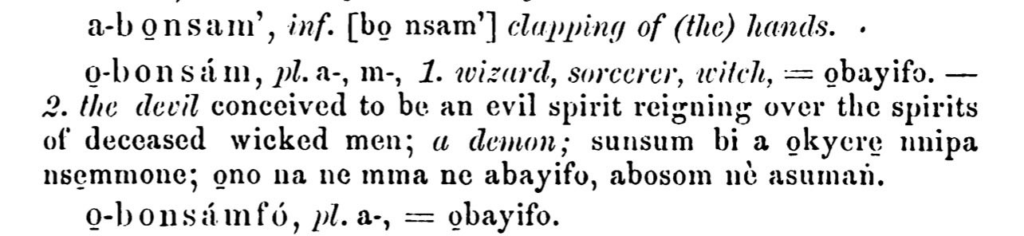
This connection becomes more apparent when one considers the expression ‘Sasa Bonsam’, the Akan term for the devil. The first element, ‘sasa’, points to the same category of wild spiritual beings associated with the wilderness and the unseen world. In essense, in his book ‘The Dictionary of the Asante and Fante Language Called Tshi’, Christaller (1881) defined ‘Sasa Bonsam’ as the devil conceived to be an evil spirit reigning over the spirits of deceased wicked men; a demon. Whether or not Saman and Sasa Bonsam share a direct linguistic origin, they belong to the same cultural landscape in which spirits, ancestors, and supernatural forces formed part of everyday understanding.
Although it is difficult to determine with certainty which explanation represents the original source of the word, both interpretations shed light on Akan thought. One emphasises the completion of human life and entry into another state of existence, while the other points to an older belief in a realm inhabited by spirits. Together, they demonstrate how Akan language preserves memories of ancient beliefs, allowing us to glimpse how earlier generations understood the relationship between life, death, and the unseen world.
Editor: Ama Gyesiwaa Quansah